Growth does not create instability. It exposes it.
Many organisations experience operational strain not because people lack effort, but because the operating model has not been intentionally designed.
When structure is unclear, leadership becomes the control system. Decisions route upward. Accountability blurs. Urgency replaces rhythm.
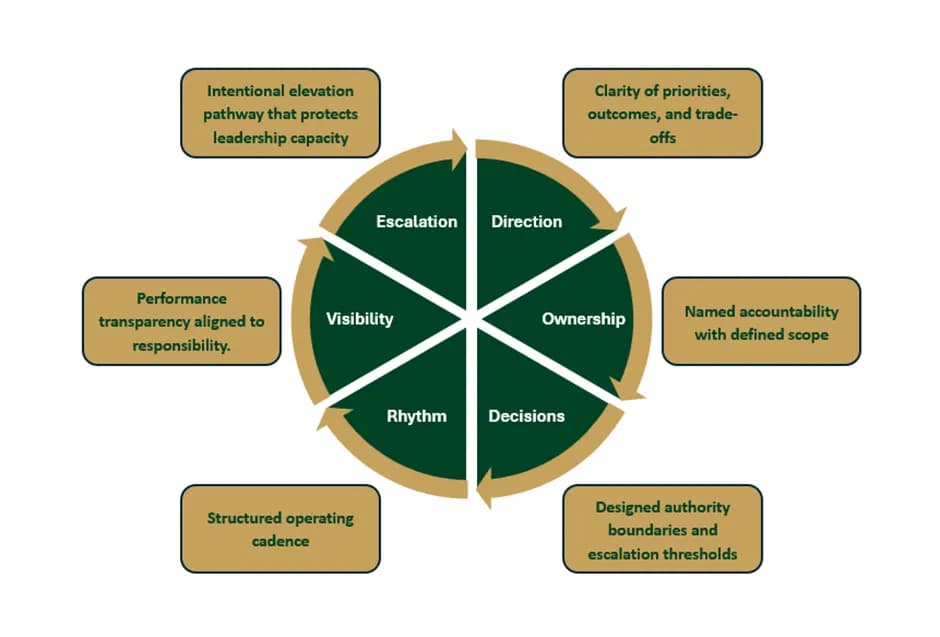
The Stability Model™ ensures the system holds, even when leadership steps back.
The Framework
The Six Components
1
Direction
Clarity of priorities, outcomes and trade-offs.
Stable organisations define what matters now, what does not, and what success looks like.
Instability shows up as shifting focus, initiative overload and leadership misalignment.
Without Direction, structure fragments.
2
Ownership
Named accountability with defined scope.
Every outcome, function and responsibility must have a clear owner and a visible standard.
Instability shows up as overlap, avoidance and emotional accountability.
When Ownership is unclear, leadership absorbs the pressure.
3
Decisions
Designed authority boundaries and escalation thresholds.
Stable systems define who decides, what requires escalation and what does not.
Instability shows up as founder bottlenecks, delayed action and unnecessary meetings.
Decisions should be designed, not negotiated.
4
Rhythm
Structured operating cadence.
Stable organisations run on predictable review cycles and defined meeting architecture.
Instability shows up as reactive leadership, firefighting and constant urgency.
Rhythm replaces chaos with consistency.
5
Visibility
Performance transparency aligned to responsibility.
Stable systems ensure meaningful metrics are visible at the right level, at the right time.
Instability shows up as surprises, gut-feel management and delivery wobble when leadership steps back.
Visibility reduces dependency.
6
Escalation
Intentional issue elevation that protects leadership capacity.
Stable systems define what escalates, when it escalates and to whom.
Instability shows up as recurring people problems, HR friction and leadership overload.
Escalation should be structural, not emotional.
What Instability Looks Like
Founder bottlenecks
Slipping delivery
Constant firefighting
HR escalation cycles
Sunday dread despite commercial success
Growth that feels heavier, not lighter
These are symptoms. The underlying issue is structural misalignment in the operating model.
What Changes When Stability Is Designed?
Decisions move at the right level
Leadership time is protected
Accountability becomes calm and visible
Delivery becomes predictable
Growth creates capacity rather than pressure
The business no longer depends on constant intervention. The system carries the load.
The Stability Model underpins all engagement work. Whether through diagnostic, structured retainer or transformation project, the objective remains the same: